
MergeHelper vs. GitLab Control
GitLab Control is a dedicated GitLab merge request menubar app for macOS. MergeHelper tracks pull requests and merge requests across both GitHub and GitLab. Here is how they compare.
GitLab Control is built exclusively for GitLab users who want a native macOS menubar experience. It surfaces merge requests, pipeline status, and other GitLab-specific activity directly from your menubar. If GitLab is your only platform and you value deep GitLab integration, GitLab Control is designed for that workflow.
MergeHelper is designed for developers and teams who split their work between GitHub and GitLab. Instead of managing merge requests on GitLab separately from pull requests on GitHub, MergeHelper brings all PRs and MRs into one unified menubar list with PR/MR event notifications, live CI, and approvals. You see everything in one place without context switching.
The key tradeoff: GitLab Control is optimized for GitLab-only workflows and may offer deeper GitLab-specific features like pipeline controls, issue tracking, and project management. MergeHelper focuses narrowly on PRs and MRs but supports both GitHub and GitLab with a consistent interface.
In short, GitLab Control is for GitLab-exclusive teams who want deep platform integration. MergeHelper is for teams that need one place to manage code review across both GitHub and GitLab.
Quick comparison
| Feature | MergeHelper | GitLab Control |
|---|---|---|
| GitHub support | ✓ | - |
| GitLab support | ✓ | ✓ |
| Unified GitHub + GitLab list | ✓ | - |
| Deep GitLab integration | Standard | ✓ |
| Self-hosted GitLab support | ✓ | ✓ |
| macOS menubar app | ✓ | ✓ |
| Pipeline and CI/CD controls | - | ✓ |
| Pricing | Free (up to 3 PRs/MRs) $12 one-time for unlimited |
Check GitLab Control website |
Screenshots
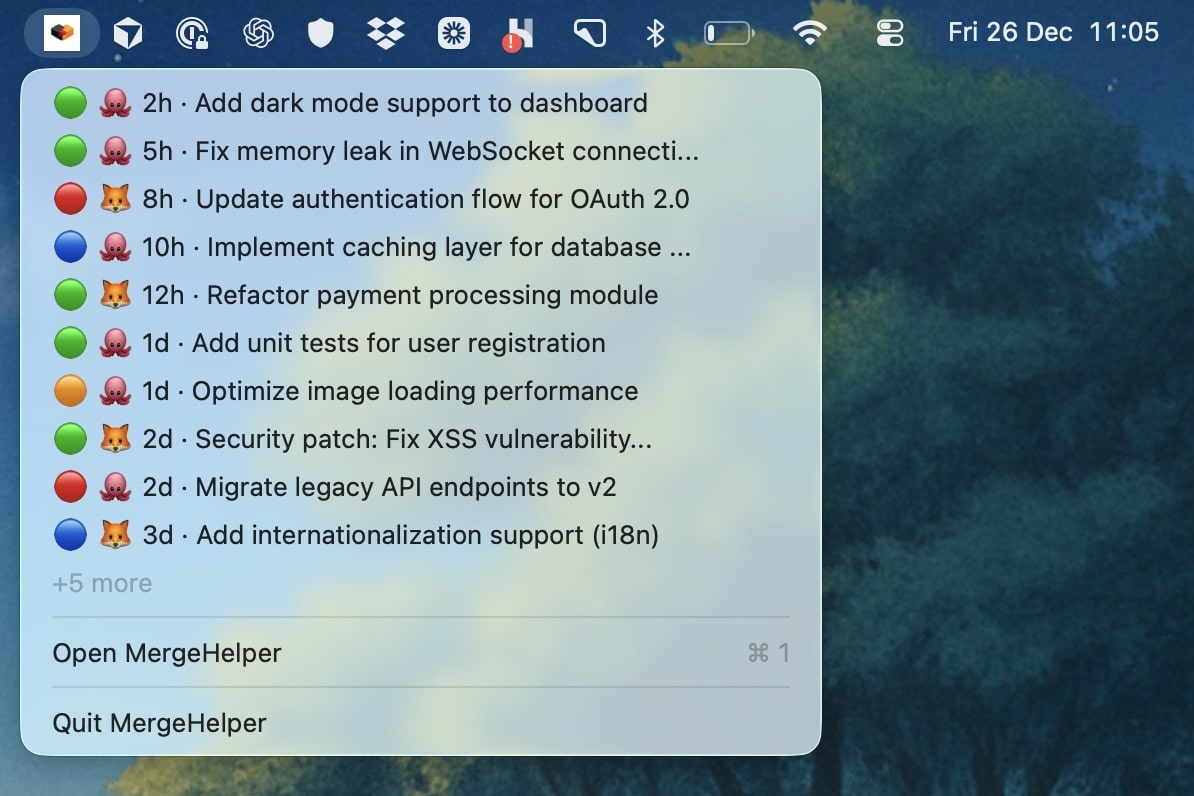
MergeHelper shows GitHub PRs and GitLab MRs together in one unified list.
GitLab Control provides deep GitLab integration from your menubar.
Detailed feature breakdown
Platform coverage and focus
GitLab Control is built exclusively for GitLab. It integrates deeply with GitLab's ecosystem and may expose features like pipeline controls, issue tracking, project management, and other GitLab-specific capabilities. If your team is all-in on GitLab, that depth can be an advantage because the app is designed around one platform's full feature set.
MergeHelper supports both GitHub and GitLab, which means it provides a consistent interface across both platforms but focuses specifically on pull requests and merge requests. The value is in the unified list: you see all your PRs and MRs side by side without switching tools, which is critical for teams that work across both platforms.
GitLab-specific features
GitLab Control may offer features like pipeline retry, manual job triggering, approval management, and other advanced GitLab capabilities directly from the menubar. This deeper integration can save time if you frequently interact with GitLab's CI/CD system or project management features.
MergeHelper focuses on the code review workflow and surfaces essential metadata like merge request status, age, author, approvals, and CI. It also links to build logs when you need to dig deeper. It does not attempt to replace GitLab's web interface for pipeline management or project administration. The goal is to keep the interface simple and focused on what needs review or merge.
Self-hosted GitLab and enterprise support
Both MergeHelper and GitLab Control support self-hosted GitLab instances, which is essential for teams using GitLab on-premise or in private cloud environments. You can configure custom URLs and credentials to connect to your internal GitLab server.
The difference is that MergeHelper also connects to GitHub Enterprise, so if your organization uses both GitHub Enterprise and self-hosted GitLab, MergeHelper can unify those environments in one app. GitLab Control stays focused on GitLab only.
User interface and information density
GitLab Control is likely optimized for GitLab's terminology, metadata, and workflow. It may surface GitLab-specific details like approval status, merge conflicts, pipeline stages, and more. This can make the app feel like a natural extension of GitLab's own interface with rich context and actionable controls.
MergeHelper uses a platform-agnostic interface that works for both GitHub and GitLab. You see similar status indicators and metadata across both platforms, which keeps the experience consistent but may not expose every platform-specific detail. The tradeoff is simplicity and unification over depth.
Update frequency and navigation
GitLab Control keeps your merge request list synchronized with GitLab and provides direct links to merge request pages. It is optimized for GitLab's review workflow and may offer additional shortcuts or actions specific to GitLab's UI.
MergeHelper uses smart polling to keep both GitHub and GitLab lists up to date. You can click through to the review page on either platform, and the app handles the navigation seamlessly. The update cadence is tuned to balance responsiveness with battery life and API rate limits.
Workflow examples
If your team works exclusively on GitLab and you want deep integration with GitLab's features, GitLab Control is a natural fit. You get a dedicated tool that speaks GitLab's language and may offer controls and shortcuts that go beyond basic merge request tracking.
If your team splits work between GitHub and GitLab, GitLab Control covers the GitLab portion. You would still need a separate tool or browser tabs for GitHub, which can reintroduce context switching. MergeHelper keeps PRs and MRs from both platforms in one list.
If you expect to expand to GitHub in the future or work with external teams that use GitHub, starting with MergeHelper can reduce a later tool switch. If you are deeply invested in GitLab and have no plans to use GitHub, GitLab Control's single-platform focus and deeper features may be a better fit.
Setup and security
GitLab Control connects to GitLab using a personal access token with appropriate scopes. For self-hosted GitLab, you configure the instance URL and provide credentials. Data is typically handled locally on your Mac, which keeps your merge request information private and fast.
MergeHelper requires tokens for both GitHub and GitLab if you use both platforms. All credentials are stored in the macOS Keychain, and data processing happens locally on your device. The app does not collect usage analytics or send your data to external servers, so you maintain full control.
Why choose MergeHelper
MergeHelper is a menubar app that unifies GitHub and GitLab pull requests and merge requests in one place. If your team uses both platforms, the unified list reduces context switching and keeps CI, approvals, and build logs close to each review item.
Even if you primarily use GitLab today, MergeHelper provides flexibility for the future. If your organization adopts GitHub for new projects or collaborates with external teams that use GitHub, you will not need to change tools or manage multiple apps.
- ✓Unified GitHub and GitLab PR/MR tracking in one menubar app
- ✓Support for self-hosted GitLab and GitHub Enterprise
- ✓Future-proof if your team adopts GitHub later
Why choose GitLab Control
GitLab Control is a solid option for teams that work exclusively on GitLab and want deep platform integration. The single-platform focus means the app can expose more GitLab-specific features like pipeline controls, approval management, and project tracking.
If you have no need for GitHub support and want an app that speaks GitLab's language natively with rich controls and metadata, GitLab Control's focus can be an advantage. It stays targeted without the complexity of managing multiple platforms.
- ✓Deep GitLab integration with advanced features
- ✓GitLab-specific controls and metadata
- ✓Single-platform focus for GitLab-only teams
Pricing comparison
MergeHelper
Free for up to 3 concurrent PRs/MRs.
$12 one-time purchase unlocks unlimited tracking with lifetime updates.
GitLab Control
Check the GitLab Control website for current pricing and feature details.
Compare more apps
The bottom line
GitLab Control is a good fit for teams that work exclusively on GitLab and want deep platform integration with advanced features. MergeHelper is for teams that need a unified view of pull requests and merge requests across both GitHub and GitLab.
If you only use GitLab and value deep integration with GitLab's features, GitLab Control's single-platform focus is a good fit. If you use both platforms or expect to in the future, MergeHelper keeps your review workflow unified across both. Teams that split work between GitHub and GitLab often see the biggest benefit because MergeHelper replaces two separate inboxes with one centralized list.